
San Benito City Directory Collections
San Benito has no confirmed city-only Polk shelf in the research record. The most exact dated collection is the Rio Grande Valley Telephone Directory cited by the UT Briscoe Center. Its regional description includes San Benito, Harlingen, Brownsville, Cameron County, and historical area codes, so it can offer a strong subscriber-and-address lead. It is not proof that every issue has a separate San Benito section, and the citation does not establish that scans are available. Treat each issue as a collection request that needs a shelf or image check.
| Collection | Years | Where Held | Access |
|---|---|---|---|
| Rio Grande Valley Telephone Directory | Selected dated issues, 1945-2005 | UT Briscoe Center citation and catalog | Confirm issue image or on-site availability |
| Texas city directories | San Benito-specific years not confirmed | Texas State Library and Archives Reading Room | On-site; staff do not perform phone or email shelf searches |
| Historical Society business directories | Exact years not posted | San Benito Historical Society Research Center | Appointment or remote research request |
| San Benito Light | 1914-1925 | UNT Portal to Texas History | Digitized page images and OCR; it is a newspaper, not a directory |
The Briscoe run begins with February 1945 and continues through March 2005, with gaps between listed issues. That makes it a useful year spine, not an uninterrupted annual sequence. A local reverse or criss-cross run has not been verified. The public library catalog also does not publish a directory shelf list, so ask a librarian before treating a catalog search as proof that a volume is held locally.
The UT Briscoe Center citation for the Rio Grande Valley Telephone Directory records the regional collection and its dated issues.
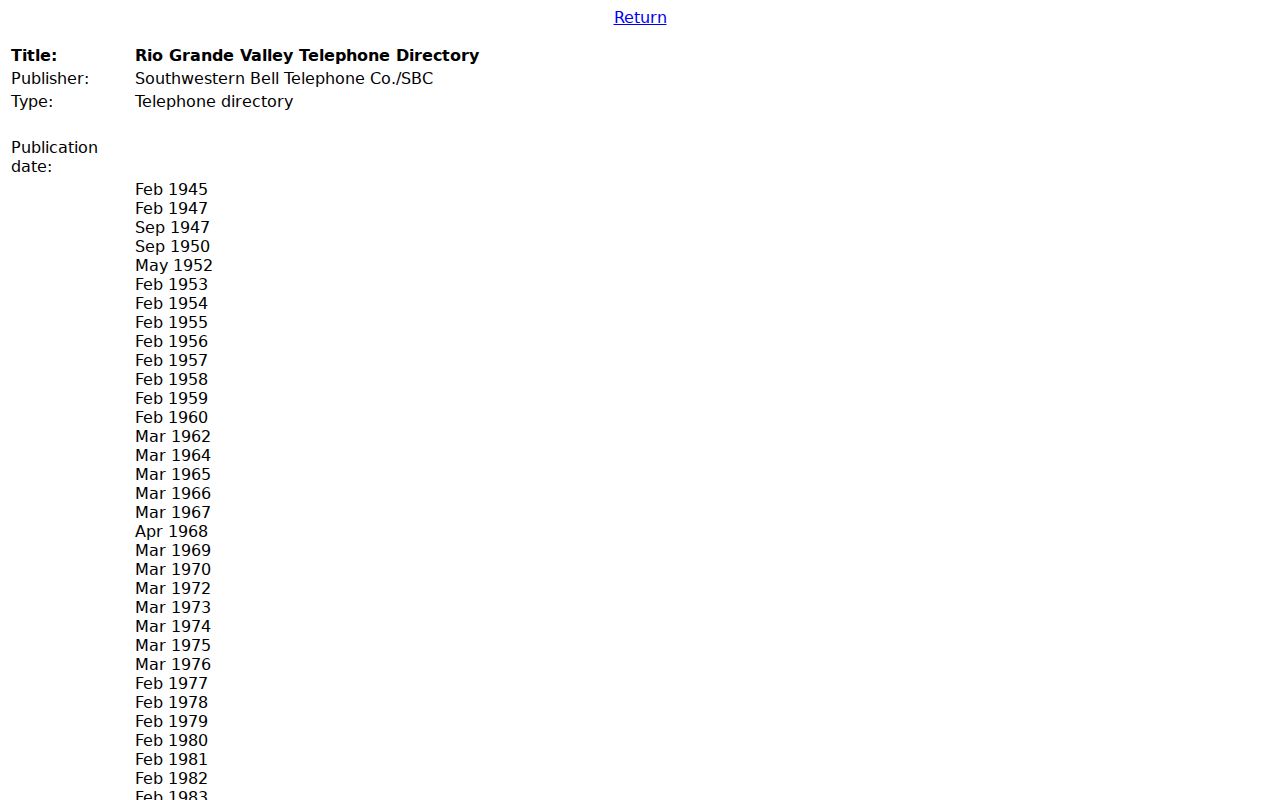
The citation is best used to request a particular year and then verify whether its pages include the needed San Benito material.
San Benito Directory News Trails
For the years before the telephone-directory run, the digitized San Benito Light gives a direct local layer. UNT lists the paper from July 1914 through February 1925 in four volumes and 21 issues. Notices, organization items, deaths, advertisements, and local events can put a surname beside a street, a business name, or a family connection. Search more than one spelling. Older OCR can miss accents, compound Spanish surnames, initials, and names printed near a column edge.
A newspaper hit is not a directory entry, but it can narrow the date for a later archive request. Read the page image after an OCR match and inspect nearby notices. A name appearing in an advertisement may be a contact or a merchant rather than a home address. Record the issue date, page, spelling, and surrounding place names before comparing it with a telephone listing or census household.
The UNT sample issue of the San Benito Light shows the digitized newspaper collection's page-image format.
Page images provide the context that OCR alone can lose, especially when a surname or address is hard to read.
San Benito Directory Desk Files
The San Benito Historical Society Research Center is the strongest locally described source for people-history work. Its holdings include people and family files, obituaries, county newspapers, tax assessment rolls, business directories, school yearbooks, great registers, cemetery records, diaries, historic maps, and photographs. A directory name can therefore lead into several independent records held in the same research center. The Society confirms business directories, but it does not publish a separate year list or confirm a local criss-cross series.
Both in-person and remote research are offered. A useful request gives the name, approximate dates, relationship, and sources already checked. The Center says it searches only its own holdings. Its stated research rate is $10 an hour for members and $15 an hour for nonmembers, with a remote backlog stated as two to three months when inspected. Appointments are arranged by email. Visitors sign in, use pencil or laptop, avoid self-service shelving, and need permission for digital photography.
The San Benito Historical Society Research Center describes its holdings, appointment process, research fees, and handling rules.
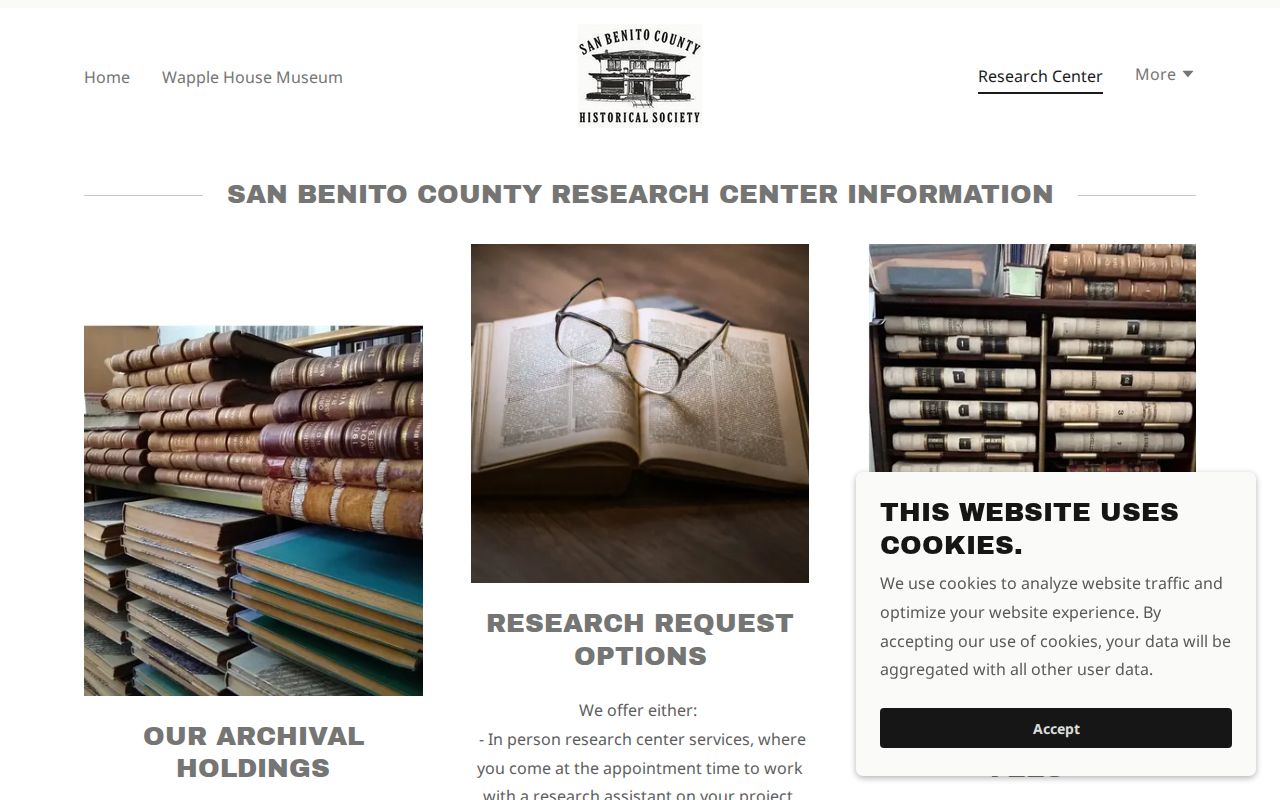
Those mixed holdings make it practical to test a directory lead against obituaries, tax rolls, yearbooks, or cemetery files without assuming that any one record settles identity.
Reading San Benito Directory Entries
No accessible San Benito directory entry or abbreviation key was captured during the research. That gap matters. The following inventory is a checklist for an actual page image, not a reconstruction of how a particular Rio Grande Valley issue was printed. Texas State Library and Archives describes fields that can appear in city directories generally, while the Briscoe citation exposes collection facts rather than an entry image.
| Printed name | Capture surname, given name, initials, and any alternate spelling exactly as printed. |
|---|---|
| Street information | Record the number, street name, and any directional word without modernizing it. |
| Telephone detail | Note an exchange or number where it appears, since it can distinguish same-name entries. |
| Family notation | Preserve a spouse, widow, or other household notation only if the actual entry shows it. |
| Local connection | Copy any printed business or organization reference as a lead for newspaper and archive searches. |
- Criss-cross section
- An address-order section, if a volume includes one, that can be checked after a name or street is known. No San Benito run has been verified.
- Householder index
- An index arranged around a household or address, useful for separating people who share a surname. Its presence must be checked in the volume.
- Abbreviation key
- The publisher's explanation of short forms, usually near the front or back of a volume. Photograph or transcribe the key before interpreting a mark.
San Benito Texas Directory Access
The Texas State Library and Archives Commission provides a broader Texas city-directory route. Its guide describes directory entries as potentially containing names, addresses, telephones, spouse information, and other clues, depending on the publisher and year. The guide does not establish a San Benito volume or a particular format. The directories are a Reading Room resource, and staff do not conduct shelf searches by telephone or email or send scans from the shelves.
That rule changes how to prepare. Search the catalog and bring likely years, surnames, and nearby city names to an on-site visit. If the correct book is not found, keep the research request narrow and ask whether a regional telephone volume, an alternate city name, or a related archival collection is more likely. The San Benito Public Library can also be asked about local-history shelves, newspapers, yearbooks, and licensed databases, but its official page does not list exact directory or microfilm years.
Tracing San Benito Directory Families
Use a household trail that preserves what each source actually says. A telephone listing is a subscriber-and-address clue, not proof of every person who lived there. The Historical Society's people files and newspapers can test a connection, while the census gives a dated household snapshot. The latest released federal decennial census is 1950. More recent census records remain restricted under the federal 72-year rule.
- Start with a known surname, initials, street, or institution and choose the closest verified telephone-directory issue or newspaper date.
- Copy the spelling, street number, telephone detail, and date exactly, including any uncertain character.
- Check the next available issue before and after that date. A gap in the Briscoe list means another source may be needed between them.
- Compare the result with the relevant released census, keeping household members, relationships, and ages separate from the directory clue.
- Use Society obituary, cemetery, yearbook, and newspaper files to test whether a disappearance reflects a move, a death, a different spelling, or an unlisted subscriber.
Keep a name-variant log for compound Spanish surnames, maternal and paternal order, accents omitted by old indexes, and initials. Do not silently correct a historic spelling. Two records can refer to the same family even when the printed form changes, but the original form is the evidence needed to search the next collection.
San Benito Directory Census Checks
The useful dates overlap unevenly. UNT's local newspaper material runs from 1914 to 1925. The verified regional telephone directory begins in 1945 and reaches 2005 with listed gaps. Federal census snapshots are available through 1950. Comparing a directory issue just before or after a census date can identify a likely address change, but it can also reveal a delayed update, a renamed street, a boarder, or two different people with the same name.
For an older address, add the historical map context and the county deed trail only after preserving the printed street form. Cameron County records reach earlier than San Benito's modern city history, and the legal description can survive when a street label changes. A directory occupant and the person named in a deed can be different people, so the records answer different questions and should remain separate in notes.
San Benito Postal Directory Clues
Postal names can explain an apparent break in a local record. San Benito's postal service began as Diaz in 1905, was renamed San Benito in 1907, and the post office moved in 2001. A reference to Diaz in an early newspaper, map, or address note may therefore be a place-name transition rather than evidence that a family moved away. Search both labels when a surname appears near the early city period.
The former post-office site at 401 N Sam Houston is also a useful historical landmark. City historical maps and named landmarks can help place an old reference when a typed modern address is absent. They should support, not replace, the original directory, newspaper, census, or deed citation.
San Benito Directory Research Gaps
Several limits should stay visible in every search log. No official local reverse-directory year run was located. No accessible San Benito entry image or publisher abbreviation key was captured. The UT Briscoe listing is regional and does not prove a city-only Polk section. The public library does not publish its local shelf inventory, and an official online cemetery-name index was not found.
Those gaps are useful instructions, not dead ends. Ask the Historical Society whether its business directories include Polk or criss-cross volumes. Ask the library for a shelf list before traveling. Request a specific UT issue after checking the citation. When a needed record remains unavailable, document the date searched, the collection, and the missing detail so a later archive visit can pick up the same trail.